Drive through almost any Henderson neighborhood in late summer and the newest artificial lawns look identical from the street — same dense green blades, same tidy borders. The real differences surface over time: the yard that stays firm after a monsoon gully-washer while the neighbor's sags into spongy hollows, the lawn that stays flat through its fifth brutal summer while another buckles at the seams by year two. That gap has almost nothing to do with the grass you can see, and almost everything to do with the engineered foundation buried beneath it. This article follows a five-part presentation on engineered turf systems, slide by slide, to show why Henderson homeowners should judge an installer by what they dig, not by what they roll out.
The Case for Looking Down First
A turf presentation could start almost anywhere — blade technology, color, warranty fine print — but this one opens by pointing down. The cover slide announces the whole argument in a single idea: a beautiful lawn is built from the ground up, and what makes a premium turf system last is decided long before the first roll of grass is unrolled. It challenges how most homeowners shop, touring Henderson showrooms to compare greens and textures when the trait that separates a ten-year lawn from a three-year one is invisible at purchase time. The cover also nods to the climate question behind all turf engineering: water. Henderson speaks that problem in a different dialect — not steady seasonal rain but monsoon bursts that flood streets in minutes; not absorbent soil but clay and caliche that refuse to drain; not freeze-thaw but summer heat that bakes whatever moisture gets trapped below.
The Ninety Percent Nobody Sees
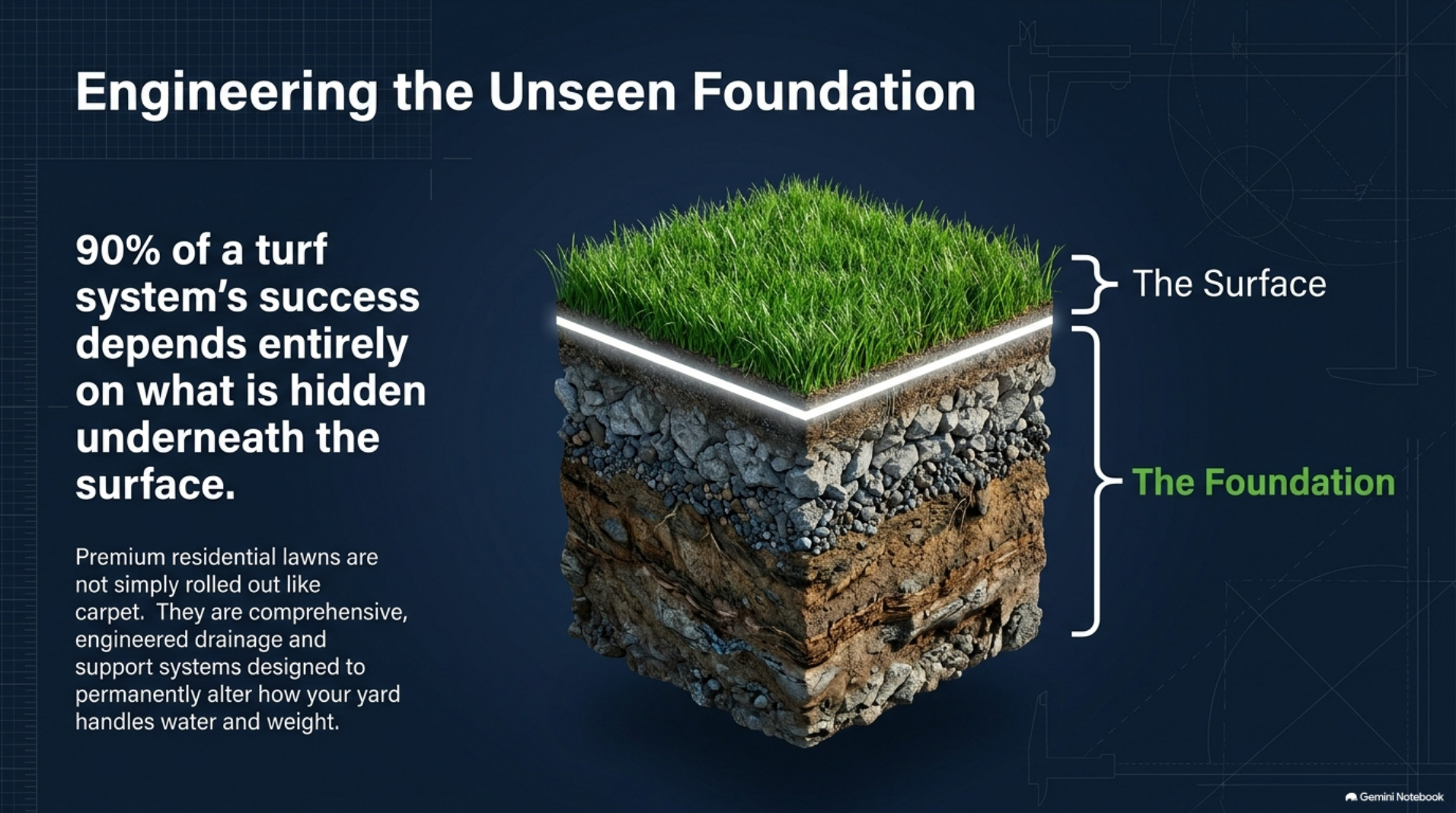
The second slide drops the number that should change how every homeowner interviews a contractor: roughly ninety percent of a turf system's success depends on what is hidden underneath the surface. It is an almost startling claim, because the grass you see — the part you paid for, the part guests compliment — accounts for only a sliver of the system's performance. Everything that keeps that grass green, flat, and firm lives below grade, out of sight until something goes wrong. The slide draws a sharp line between two very different products: premium lawns are not rolled out like carpet but built as engineered drainage and support systems designed to permanently change how a yard handles water and weight. Permanently is the operative word in Henderson, where water arrives violently — monsoons can dump an inch of rain in under an hour onto ground that barely absorbs it — and weight is a daily, four-legged reality: dogs tearing laps along the fence, patio furniture, kids at full sprint. A lawn built to manage both forces for the long haul is not an installation. It is construction.
Anatomy of a Lasting Turf System
The third slide pulls back the curtain with an exploded cutaway view revealing five distinct layers, each doing a job the surface cannot do alone. At the very top sits the artificial turf surface: durable blades engineered to shed water rapidly and resist matting under heavy foot traffic. That spec matters twice over in Henderson — fast shedding keeps monsoon water moving instead of beading, and matting resistance keeps the lawn standing upright through a summer of dogs and backyard entertaining. Beneath the blades comes the infill support layer, a heavy granular ballast with three quiet jobs: it adds critical weight to hold the system down, props individual blades upright so the lawn keeps its fresh-cut look, and protects the turf backing from grinding against the base. Skip or skimp on infill and the proof shows up in flattened, shiny traffic lanes within a season or two.
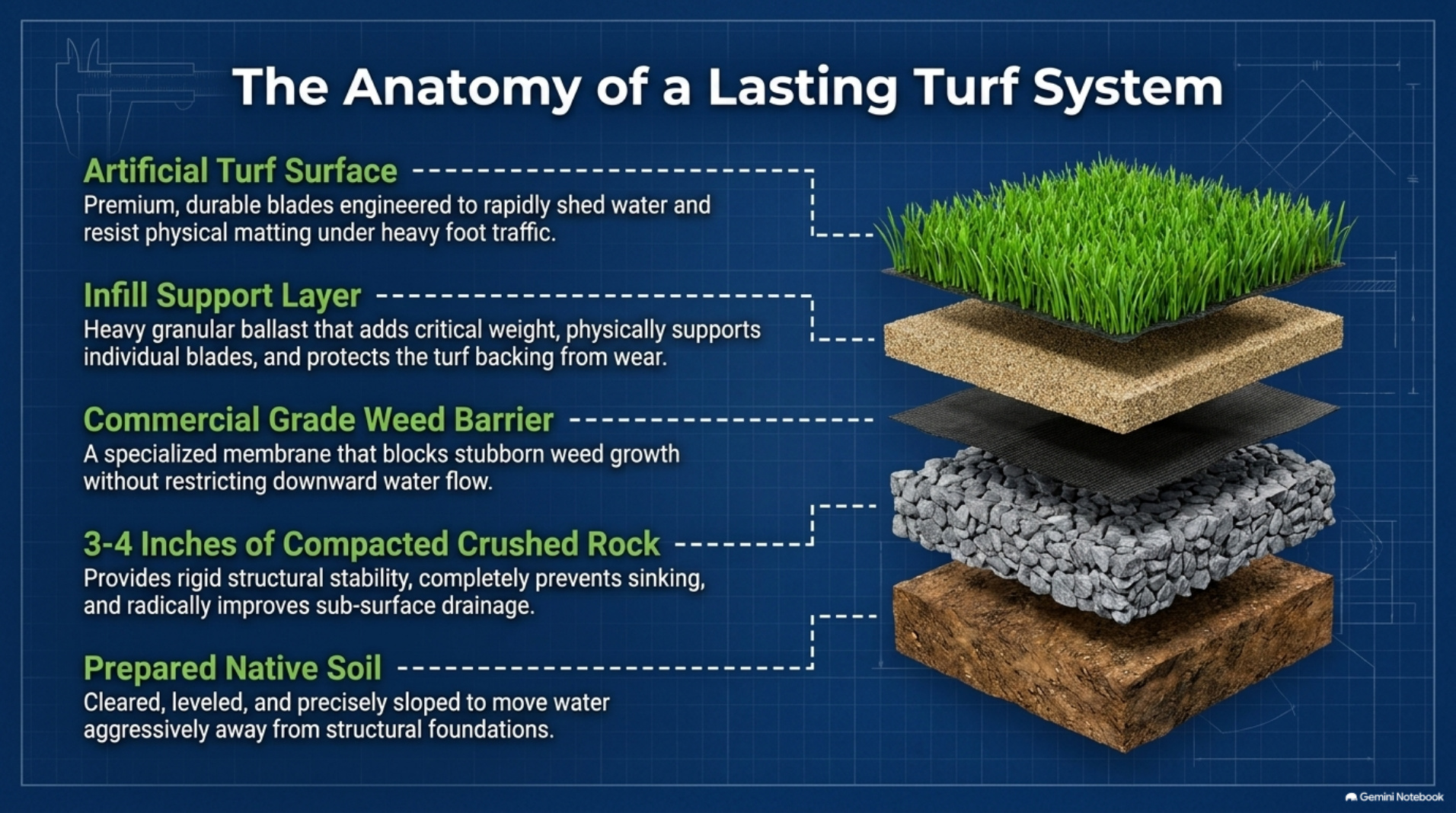
Below the infill sits the commercial-grade weed barrier, a membrane that blocks stubborn growth from below without restricting the downward flow of water — important in a valley where bermudagrass runners and nutsedge tubers treat cheap landscape fabric as a polite suggestion. The fourth layer is where the real engineering happens: three to four inches of compacted crushed rock, delivering rigid structural stability, making sinking physically impossible, and radically improving subsurface drainage. It is also Henderson's quiet answer to clay and caliche, which heave and settle with every change in moisture. At the bottom sits the prepared native soil, cleared, leveled, and precisely sloped to move water aggressively away from the foundation. In the desert that preparation carries double weight, because it means confronting whatever the builder left behind — hardpan, rubble, and expansive clay that must be corrected before anything lasting can sit on it.
Where Cheap Lawns Fail First
The fourth slide turns forensic, listing three failure modes every turf installer has seen in the field and pairing each with the engineered fix. First symptom: water pooling and soft spots, answered by a rapid drainage system — three to four inches of compacted crushed rock that lets water flow through instead of trapping it at the surface. In Henderson, standing water is never just cosmetic: flash-flood runoff hunts out the low spots where clay has settled, and a chronically soft patch becomes a sagging, soupy hazard for dogs and bare feet. Second symptom: wrinkles and seam movement, answered by structural lock-in — heavy infill plus a rigidly compacted subgrade that anchors the turf permanently, regardless of temperature shifts. That caveat matters enormously here, where 110-degree afternoons falling into the seventies at night rank among the country's most punishing thermal cycles, and any surface not held down tight will crawl, ripple, and pull its seams apart.
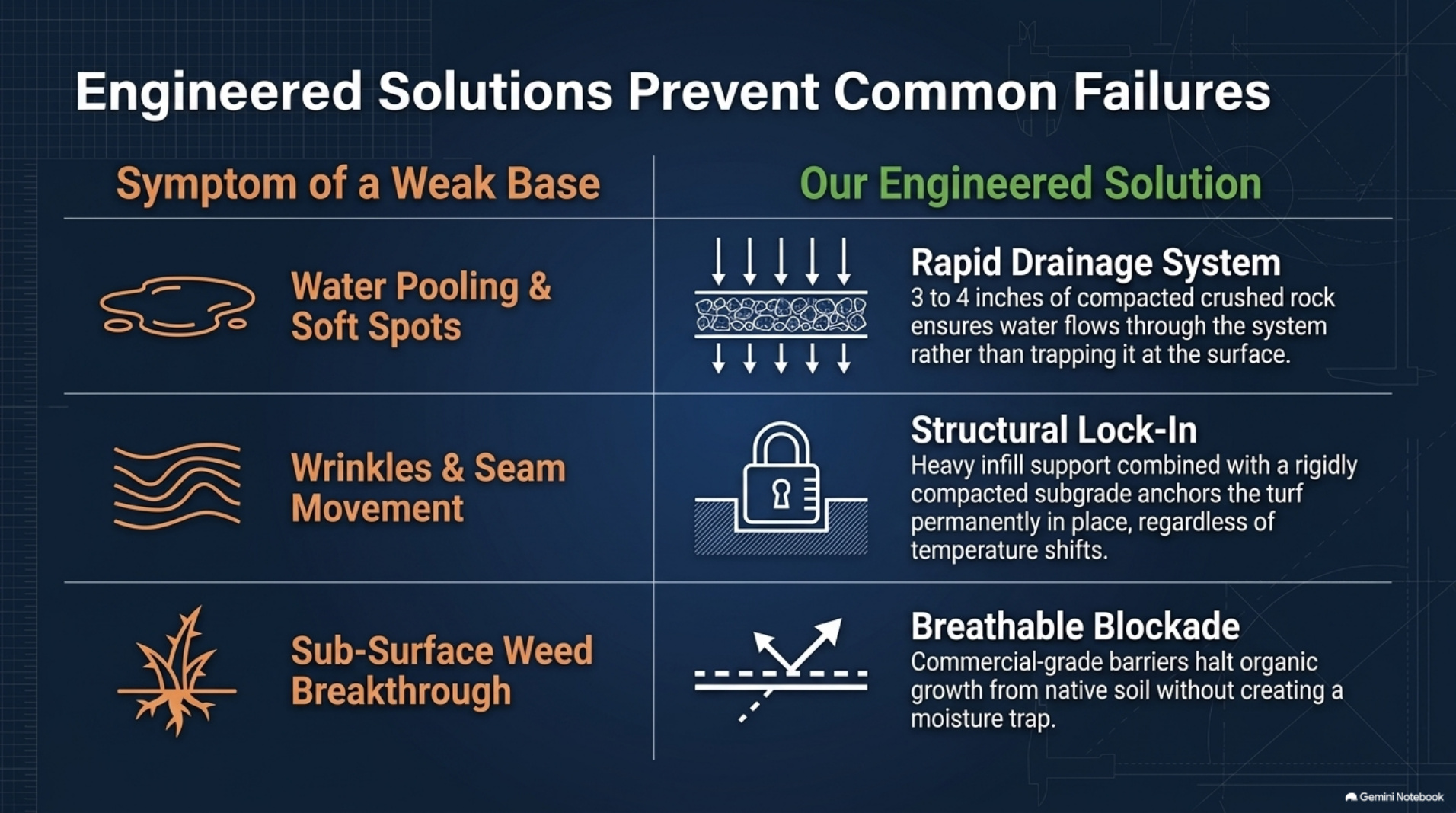
Third symptom: subsurface weed breakthrough, answered by a breathable blockade — commercial-grade barrier fabric that halts growth from the native soil without creating a moisture trap, the worst desert failure of all, since water sealed beneath the turf bakes in the summer sun into odor and degraded backing. What ties the three fixes together is one observation: every failure traces back to a weak or hastily prepared base, and every solution is simply base engineering done properly the first time.
The Deep Base: Insurance You Can Walk On
The final slide makes the argument that ties the deck together: a deeply compacted base of three to four inches of crushed rock is the ultimate insurance policy for a turf investment. The presentation was built around wet climates, where that spec is essential for stability, protection against sinking, and subsurface drainage — and the honest adaptation for Henderson is that this valley faces the same problems on its own schedule. Clay and caliche hold water like a bowl, so when the monsoons roll through, a Henderson yard briefly behaves like a wet-climate yard: runoff piles up, the ground saturates, and anything not built to drain sits in that moisture for days. Then the sun returns and bakes whatever got trapped, driving the expansion and contraction that buckles cheap installs. The deep base fixes both worlds at once — it moves flash-flood water out fast when storms hit, and it keeps the lawn from sinking, heaving, or shifting as the desert soil swells and settles through the seasons.
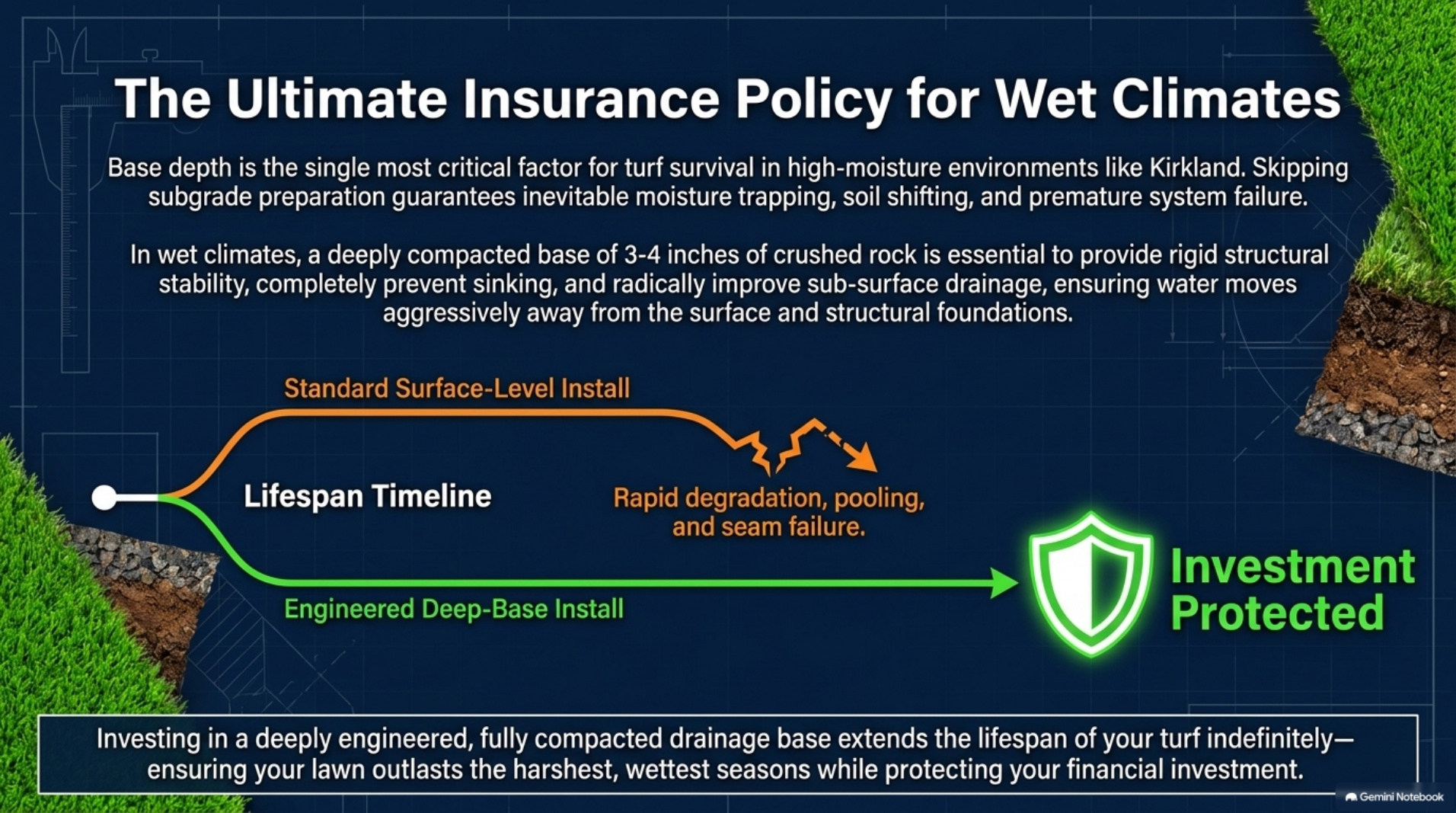
The slide closes with the blunt contrast homeowners actually experience. A standard surface-level install over unprepared ground delivers rapid degradation, pooling, and seam failure within a handful of seasons. An engineered deep-base install extends the lawn's life dramatically — the difference between replacing your backyard in a few years and watching it outlast the harshest seasons Henderson can throw at it. Framed that way, the extra inches of crushed rock stop looking like an upsell and start looking like what they are: a one-time cost paid up front so the lawn protects your investment for decades instead of draining it every few years. Pay once for a foundation that holds, or pay again and again for a surface that never had one.
Ready to build on a foundation that lasts?
Tell us about your Henderson yard and get matched with pre-vetted local turf pros who engineer the base right — free, no obligation.
Get Free Matches