Optimal Turf Subgrade and Base Engineering: The Structural Specs That Matter
Ask most Henderson homeowners what makes artificial turf last and they will talk about blade color, infill quality, or the warranty card in the drawer. Ask the engineers who design commercial sports surfaces and they will change the subject: the conversation starts at the dirt. The structural specifications, load-bearing dependencies, and hydrological risk management buried below the blade line decide whether your yard still looks new in year eight or starts rippling, sinking, and pooling by year two. This guide walks through that engineering deck slide by slide, and what each spec means for a Henderson backyard on clay and caliche that has to survive July monsoons and daily pet traffic.
The Layer Stack: Everything Below the Blade Line Earns Its Place
The deck opens with the whole system drawn bottom-up, and the first surprise is that the turf is only one of five layers: prepared native soil, then three to four inches of compacted crushed rock serving as the aggregate base, then a commercial-grade weed barrier, then an infill support layer, and finally the artificial surface. Each layer has one job: the soil must be a stable platform, the aggregate must carry load and move water, the barrier must block organic intrusion, the infill must anchor the surface, and the turf rides on top of it all.
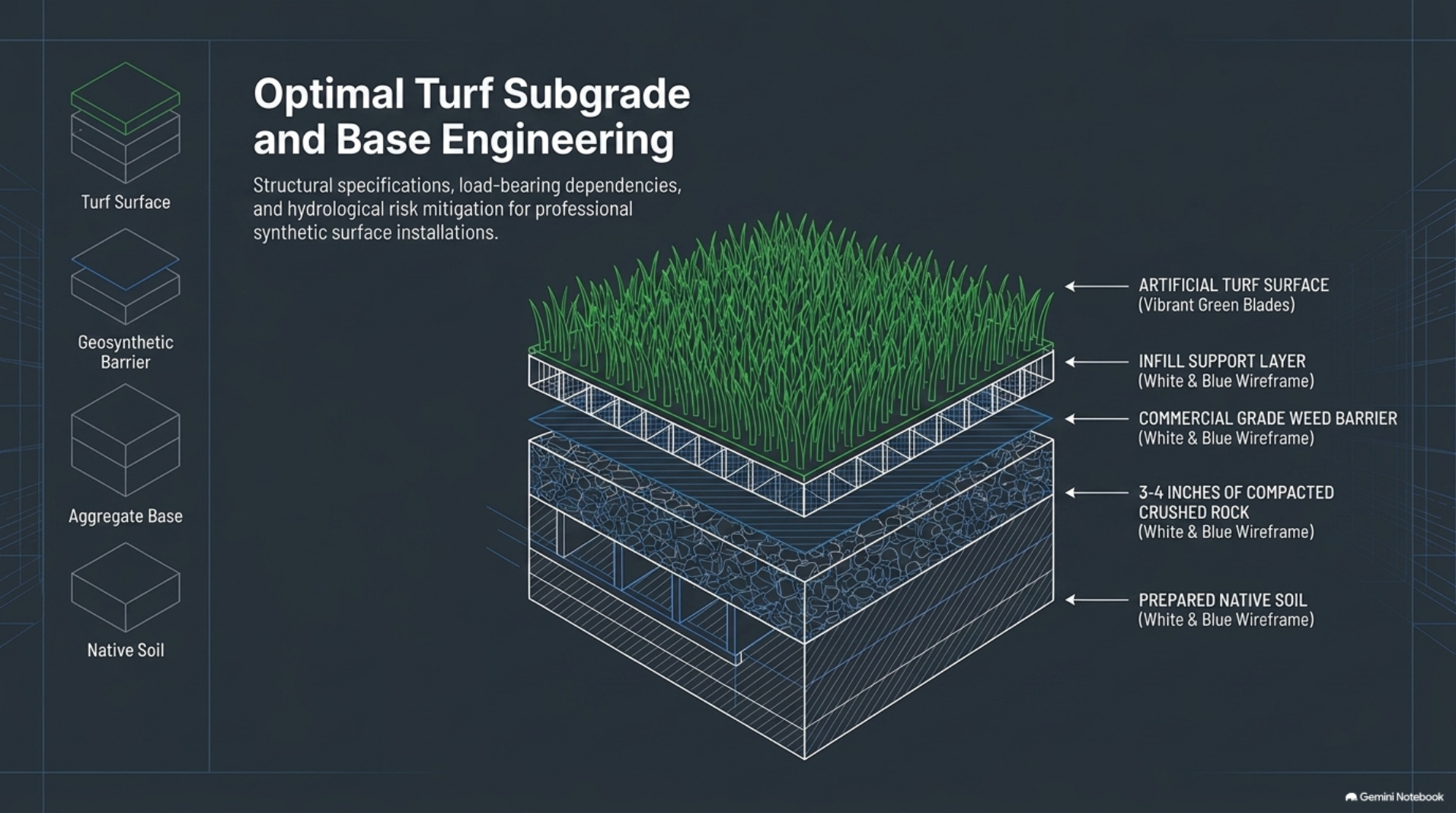
The soil underneath is why this matters in Henderson. Expansive clay swells when it gets wet and shrinks as it dries, while caliche can be rock-hard on top yet riddled with voids beneath. Turf laid directly on that ground inherits every movement of the soil below. Notice the geosynthetic barrier drawn between native soil and aggregate: it keeps fine clay particles from migrating up into the rock, where they would clog the voids the base relies on for drainage. When an installer quotes a job as "we will skim it, lay the turf, and infill it," the layer stack is the first thing that has gone missing.
The Grade Vector: Water Obeys the Slope You Give It
Slide two introduces the grade vector, and the argument is blunt: foundational grading dictates the hydrological success of the entire system. Before a single stone is placed, the native soil must be leveled within a tight tolerance, because dips and humps below translate into uneven base thickness above. Where the aggregate runs too thin, the base nearly disappears; where it runs too thick, it settles unevenly. A true subgrade means the base above holds a perfectly uniform depth, so load-bearing behavior is identical across the yard.
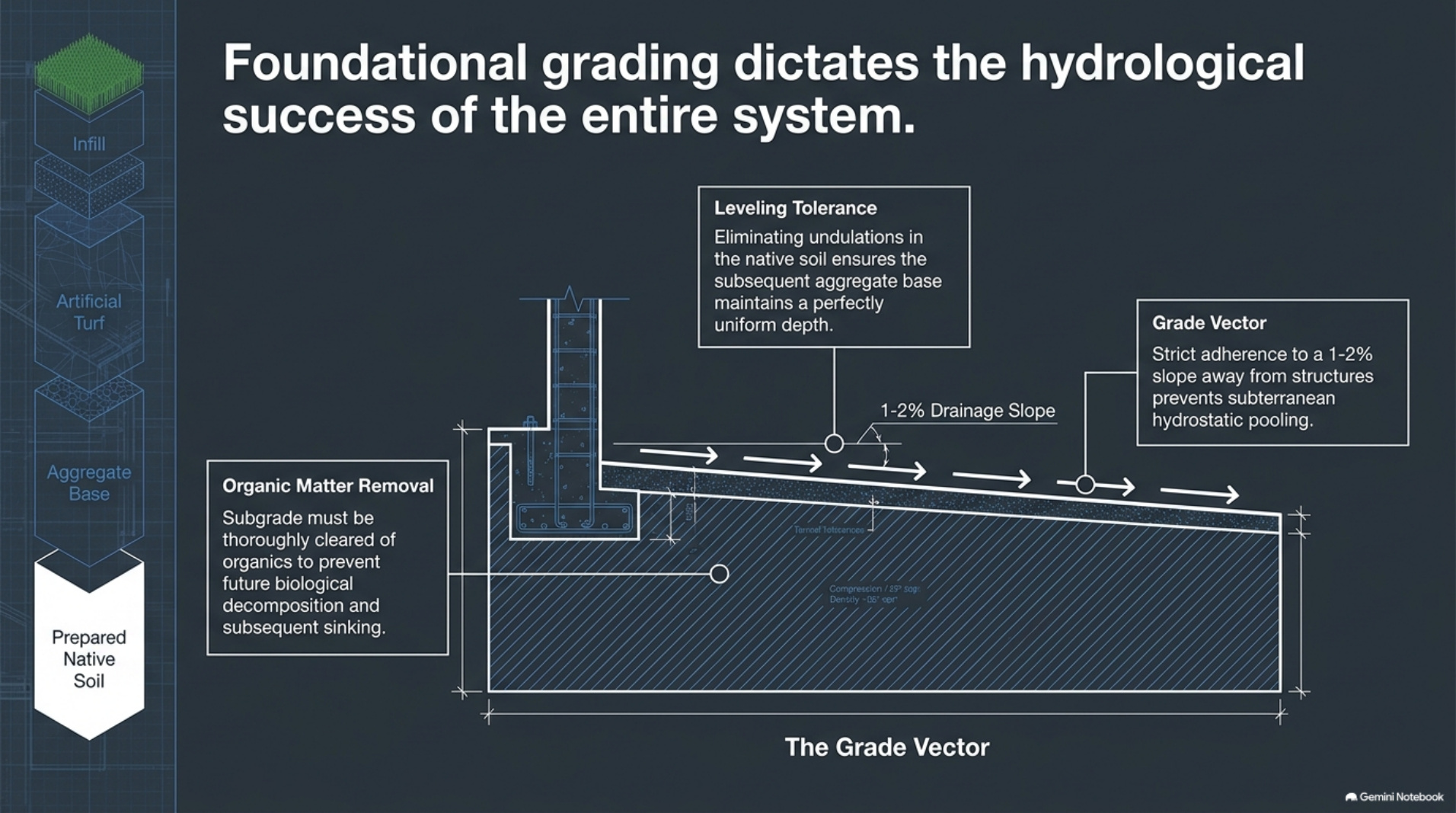
The slide pairs leveling with the drainage rule that matters most in a monsoon climate: a one to two percent slope running away from structures. That gentle fall is the difference between water shedding off the lawn and water lingering under the turf until it becomes hydrostatic pooling against your foundation, patio slab, or block wall. The third mandate is organic matter removal: roots, sod remnants, and buried vegetation must be stripped from the subgrade; anything organic left below will decompose, lose volume, and sink, taking the turf down with it. Vetting question for this slide: what leveling tolerance do they hold, where will the one to two percent slope run on your lot, and do they strip organics before grading?
The Compaction Micro-View: Crushed Rock, Density, and Why 95% Is the Number
Slide three zooms in on the aggregate and gets specific, because vague promises do not survive contact with a loaded yard. The material spec is Class 2 aggregate road base: crushed rock screened to three-quarter-inch minus, meaning nothing larger than three-quarters of an inch passes through. The jagged profile is the point. Fractured edges lock together under compaction the way round river gravel never will, distributing weight and resisting sinking, while the voids between particles stay open enough to drain water far faster than the native clay beneath them ever could.
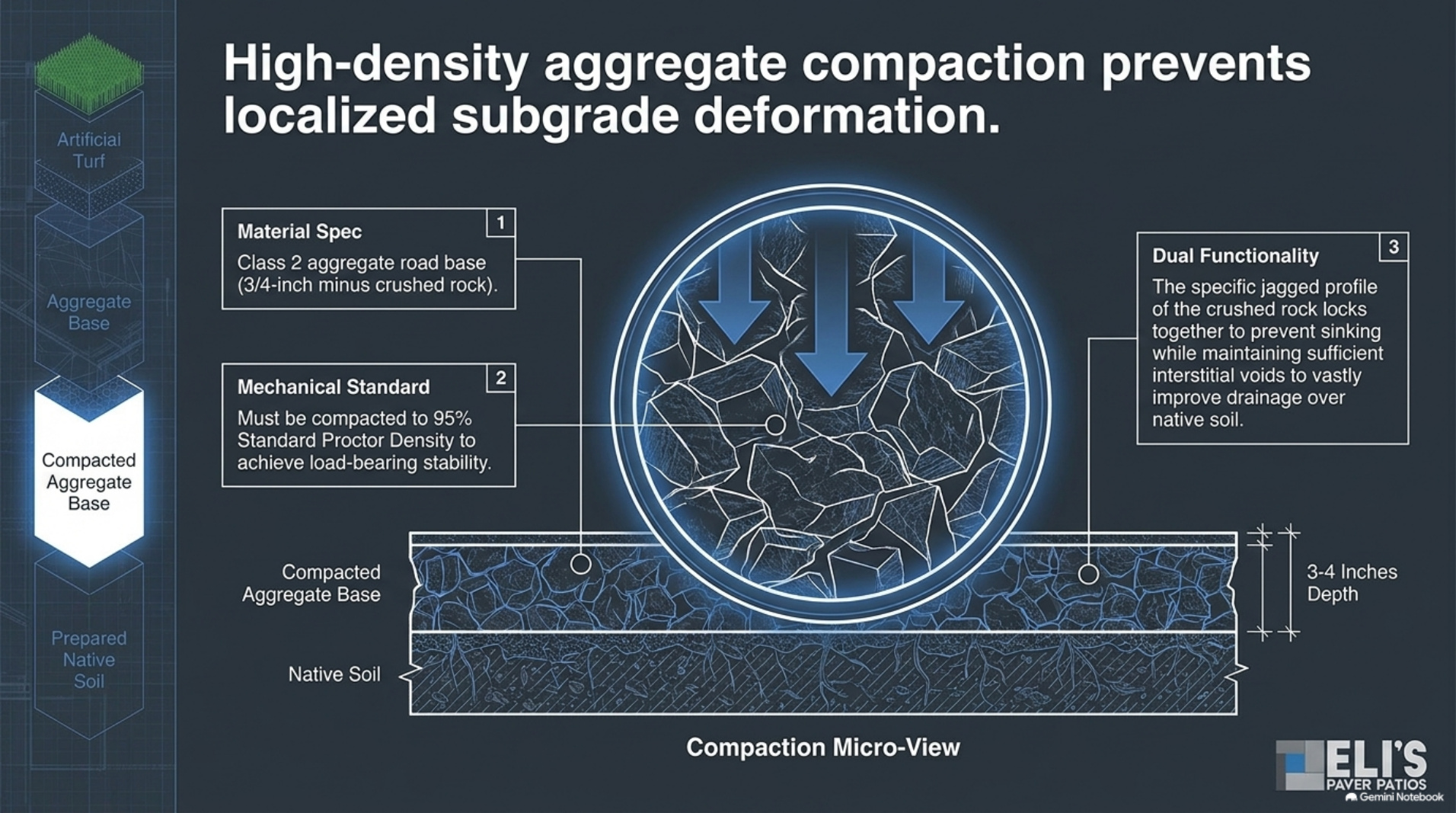
That interlocking only becomes load-bearing when the base is compacted to a defined standard: 95% Standard Proctor Density, the industry benchmark for compaction. At that density the base behaves like a rigid slab rather than a loose pile of gravel, which prevents localized subgrade deformation under a heavy point load. Depth closes the spec: three to four inches of compacted aggregate over the prepared native soil, no thinner. In a Henderson pet yard, where a seventy-pound dog hits the same patch every day, properly compacted road base is the difference between a stable surface and soft pockets under the run path. Ask for the three numbers by name: Class 2 road base, three-quarter-inch minus, compacted to 95% Standard Proctor at three to four inches, and note how quickly the installer answers.
Geosynthetics and Infill Ballast: Bracing the Surface Against Real Life
Slide four moves up the stack to the two components that brace the surface against everyday environmental stress: the barrier and the infill. The barrier here is not the thin landscaping fabric sold at the hardware store; it is a commercial-grade geotextile engineered for high permeability. It must be dense enough to block organic intrusion, stopping weed seeds and rhizomes from below, yet open enough to let water pass straight down into the aggregate rather than ponding on top. A barrier that cannot drain turns your lawn into a bathtub liner, so permeability is specified right alongside weed blocking.
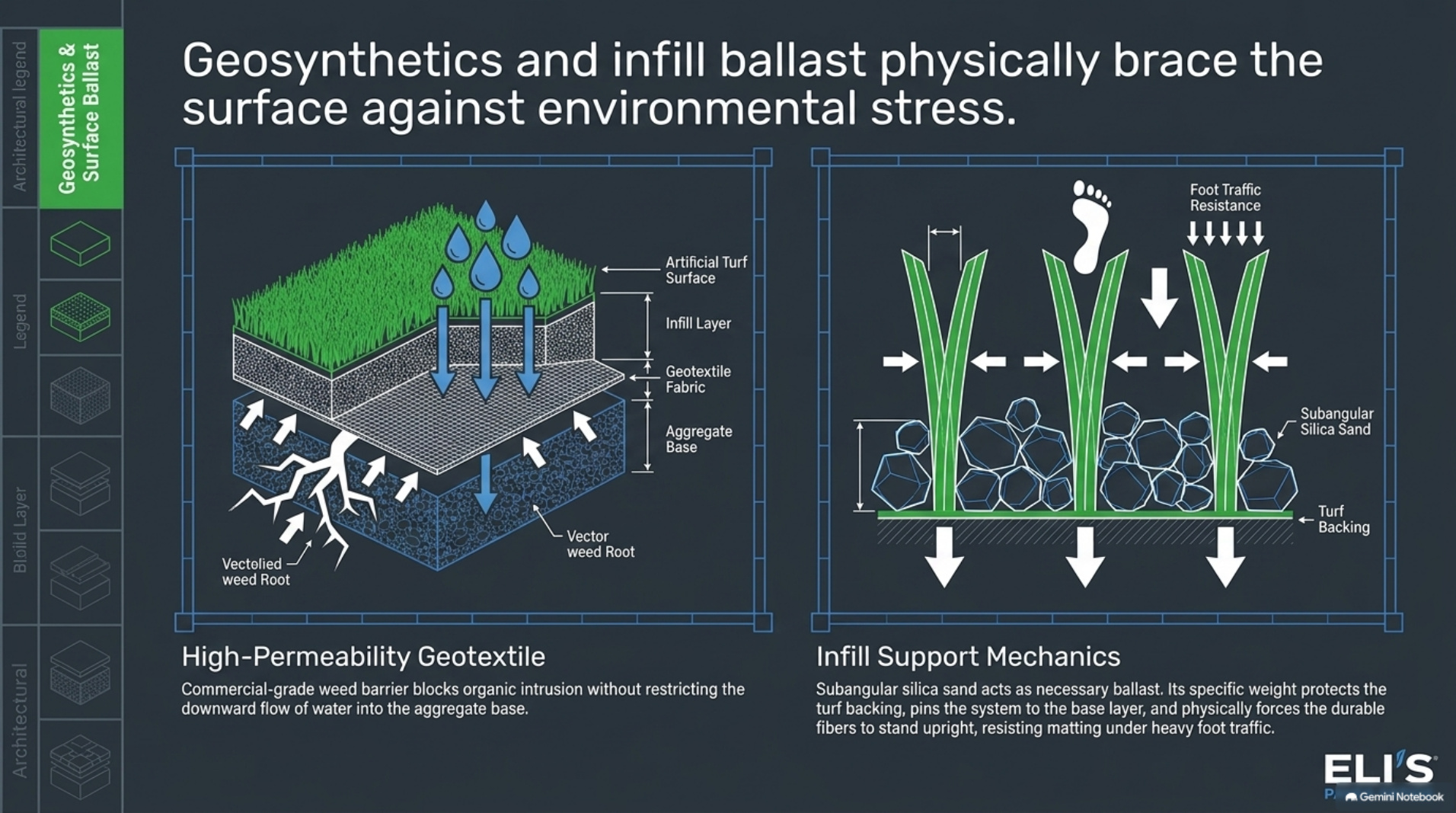
Above the barrier sits the infill support layer and the physics of ballast. Subangular silica sand does more than soften the surface: its specific weight pins the whole system to the base below, protects the turf backing from movement and abrasion, and physically forces the durable fibers to stand upright instead of matting flat. In a pet yard the stakes are visible too, because urine must drain through sand and barrier into the aggregate instead of pooling at the surface. When vetting installers, ask what sand spec they use, how many pounds per square foot they install, and whether their geotextile is rated for high water flow, then compare the confidence in their answers.
The Diagnostic Comparison: Base Depth as the Line Between Fine and Failing
The final slide turns the deck into a diagnostic table with a blunt headline: engineered base depth is the primary mitigator of catastrophic system failure. An under-engineered base of less than three inches and an optimized base of three to four inches diverge across three risk dimensions, and the contrasts are worth reading slowly.
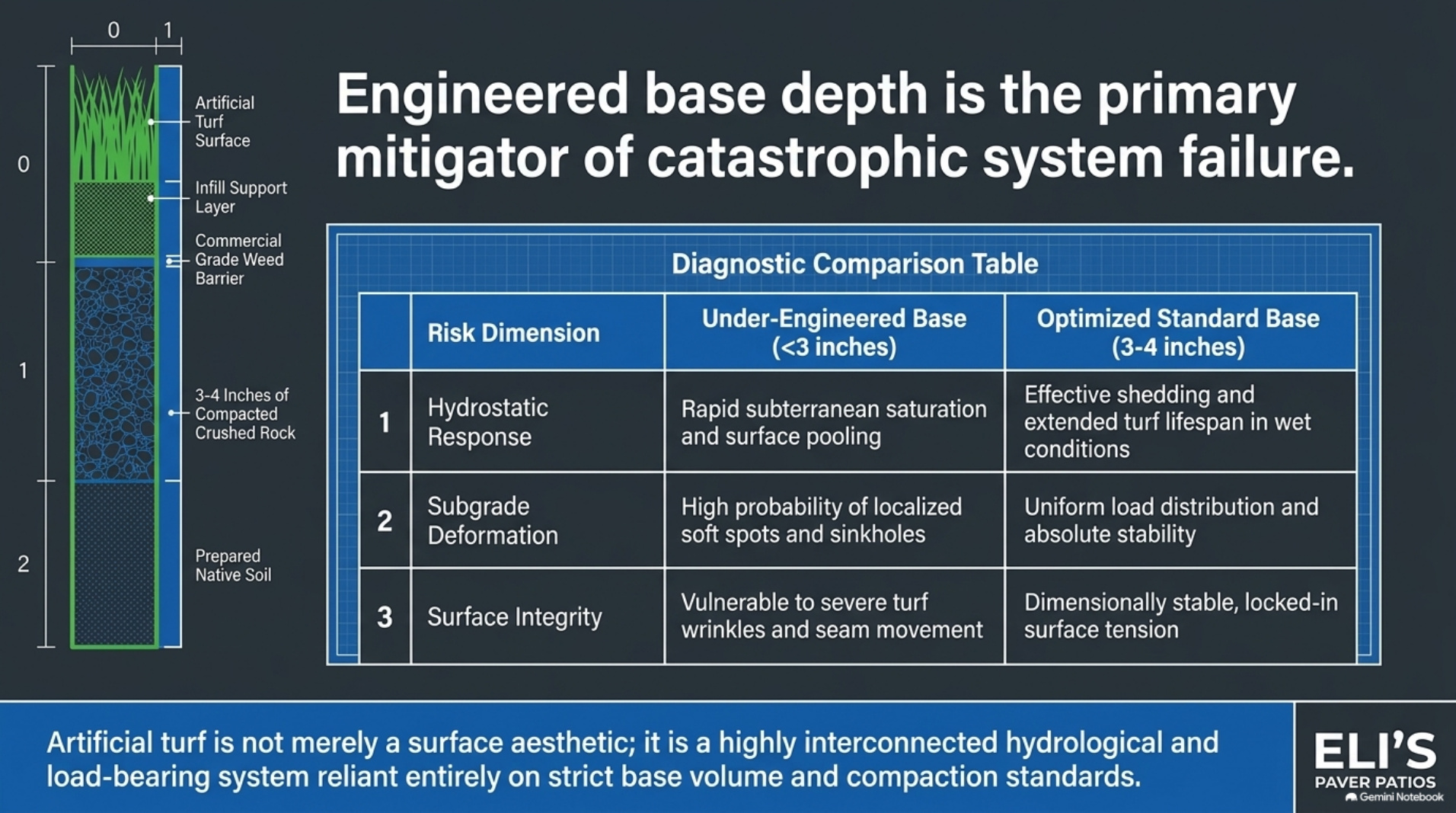
| Risk Dimension | Under-Engineered Base (less than 3 in) | Optimized Base (3-4 in) |
|---|---|---|
| Hydrostatic Response | Rapid subterranean saturation and surface pooling after rain | Effective shedding that extends turf lifespan in wet conditions |
| Subgrade Deformation | High probability of localized soft spots and sinkholes | Uniform load distribution and absolute stability |
| Surface Integrity | Vulnerable to severe wrinkles and seam movement | Dimensionally stable with locked-in surface tension |
Translated into a yard, the rows write the story themselves. Under-engineered, a monsoon saturates the shallow base until water pools on the surface and lingers against the backing; weeks later, uneven settlement shows up as soft spots and small sinkholes, and the fabric wrinkles while the seams creep apart. Optimized, rain sheds through turf and sand, crosses the permeable barrier, and disappears into three to four inches of compacted aggregate, while the dense interlocked base spreads every load evenly enough that the surface stays flat and the seams hold for years. That is why base depth is the number to insist on, not the color of the grass.
Sitting down with an installer, the whole deck shrinks to a short quiz: the base depth, the aggregate class, the compaction density, where the one to two percent slope runs, the permeability rating of the barrier, and the pounds of silica sand per square foot. A contractor who answers with specific numbers is building the system the engineers drew. One who waves the questions off is betting your lawn on the shallow side of the table, and in Henderson, the soil and the monsoon will eventually collect on that bet.
Want an installer who can prove the specs?
Get matched with pre-vetted Henderson turf pros who build to 95% Standard Proctor on a 3-4 inch crushed-rock base — free, no obligation.
Get Free Matches